
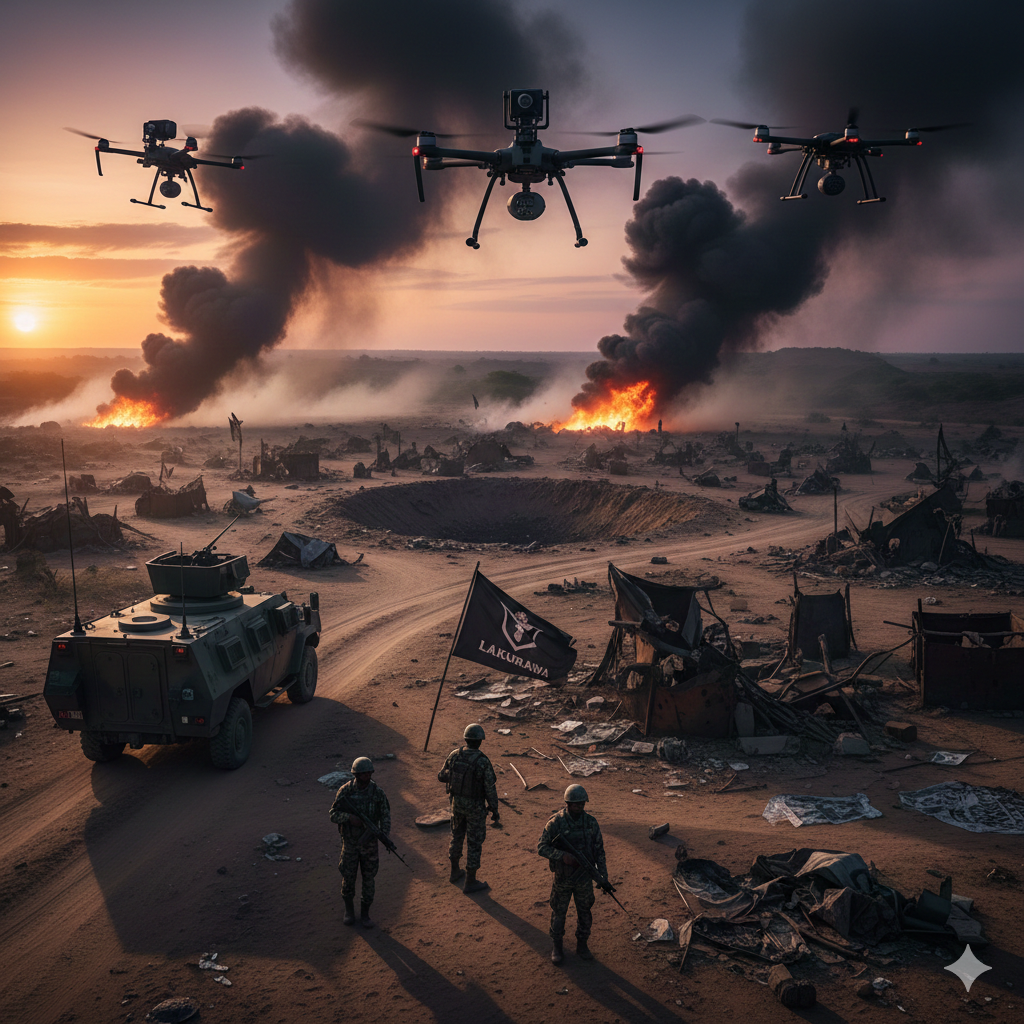
U.S. Airstrikes in Sokoto Nigeria: A Decisive Blow to Lakurawa Militants
The global security landscape shifted dramatically this week as the world witnessed U.S. airstrikes in Sokoto Nigeria, targeting the burgeoning threat of the ISIS-linked Lakurawa group. In a Christmas Day operation that caught many by surprise, U.S. Navy warships in the Gulf of Guinea launched Tomahawk cruise missiles aimed at dismantling the operational hubs of radical insurgents. These powerful and deadly strikes represent a significant escalation in international counter-terrorism efforts within the Sahel region, signaling a “new phase” of military engagement on Nigerian soil.+2
Reports indicate that the U.S. airstrikes in Sokoto Nigeria specifically focused on the Bauni Forest in the Tangaza Local Government Area, a known stronghold for the Lakurawa militants. While President Donald Trump framed the intervention as a direct response to the persecution of Christians, the tactical reality on the ground shows a concerted effort to neutralize the Islamic State-Sahel Province (ISSP). For many Nigerians, the precision of these strikes is a welcome relief after years of battling an insurgency that has overstretched the domestic military and displaced thousands of innocent civilians.
The aftermath of the U.S. airstrikes in Sokoto Nigeria has left many searching for clarity regarding the total number of casualties among the insurgent ranks. While the U.S. Africa Command (AFRICOM) has confirmed that “multiple” militants were neutralized, the Nigerian government has been more cautious, awaiting a full battle damage assessment from the joint operations team. This lack of a specific body count hasn’t dampened the narrative that the Lakurawa group, which has terrorized border communities with illegal levies and harsh Sharia enforcement, has suffered a crippling setback.
In the wake of the U.S. airstrikes in Sokoto Nigeria, local residents in villages like Jabo and Birikini described scenes of “fire and fury” as projectiles illuminated the night sky. Although the primary targets were militant camps deep within the forests, some debris reportedly fell near civilian settlements, causing widespread panic and confusion. Fortunately, local authorities and the Sokoto State Government have confirmed that there were no civilian casualties, though the psychological impact of seeing global military might in their backyard remains profound.+2
The Nigerian government’s official response to the U.S. airstrikes in Sokoto Nigeria has been one of strategic alignment and sovereignty preservation. Foreign Minister Yusuf Tuggar emphasized that the operation was a result of intense intelligence sharing and strategic coordination between Abuja and Washington. By framing the strikes as a “joint collaboration,” the Tinubu administration seeks to reassure the public that these actions are not an infringement on national pride but a necessary partnership to secure the volatile Northwest.+1
However, the U.S. airstrikes in Sokoto Nigeria have also sparked a heated debate regarding the timing and the political rhetoric surrounding the mission. With the strikes occurring on Christmas Day, some analysts worry the timing could be exploited by hardline propagandists to fuel a narrative of a Western “crusade” against Muslim-majority regions in the North. Balancing the need for kinetic military action with the delicate religious fabric of Nigeria remains a primary challenge for both the Pentagon and the Nigerian high command.
Beyond the immediate tactical gains, the U.S. airstrikes in Sokoto Nigeria highlight the growing threat of the Lakurawa, a group that originally entered the region as “protectors” before evolving into an oppressive insurgent force. These militants, primarily foreigners from the Sahel, have utilized the porous borders between Nigeria and Niger to establish a shadow government. The recent U.S. intervention serves as a stark warning that their expansionist goals are now under the direct scrutiny of global superpowers.
As Nigerians continue to monitor the fallout of the U.S. airstrikes in Sokoto Nigeria, the focus is shifting toward the sustainability of this counter-terrorism strategy. Military experts argue that while airstrikes can decapitate leadership and destroy logistics, the 70% of the solution lies in good governance and addressing the underlying poverty that makes recruitment easy. The “perfect strikes” celebrated by Washington must be followed by a sustained presence of the Nigerian state in these remote, underserved borderlands to ensure the vacuum isn’t filled by new extremist elements.
The U.S. airstrikes in Sokoto Nigeria have also had an immediate impact on regional trade and movement, with security operatives barricading strike sites and cordoning off areas for further investigation. Residents in Jabo reported finding shrapnel “as big as a car’s gearbox,” a testament to the sheer power deployed during the mission. As the dust settles, the Nigerian military has stepped up its ground patrols, attempting to reassure a rattled population that the worst of the “fire and fury” has passed.+1
Ultimately, the U.S. airstrikes in Sokoto Nigeria stand as a watershed moment in the West African war on terror. Whether this marks the beginning of a prolonged U.S. air campaign or a singular, high-impact warning remains to be seen. What is clear, however, is that the Lakurawa and their ISIS affiliates can no longer operate in the shadows of the Tangaza forests without fear of a sudden, deadly response from the skies.
This incident left Nigerians wondering after hearing the news